Henna: the plant, the technique and the tradition
What speaks to me most about henna is that it is not merely a decorative art form. It weaves together creativity, craft, a natural material, the body as a creative surface and a long and varied cultural tradition.
For me it is not just drawing a pattern on skin. Behind henna there is a whole world that I want to share with others through this workshop.
In everyday life there are fewer and fewer activities where we simply have to stop, slow down and make something with our own hands. Especially as adults.
For children, drawing, painting, making and experimenting are a natural part of the day. As adults, though, we tend to treat creative activities as something that needs a special talent or a practical reason.
We need activities that help us step out of the everyday for a while, focus on the moment and do something simply because it brings joy.
Henna is a wonderful way to do that. You don’t have to be an artist or know how to draw. Curiosity and a wish to try are enough.
I also love that henna creates a chance to do something together. Both adults and children can take part in the workshop — a mother and daughter, friends or other family members, for example. Together you can learn, practise and in the end create something beautiful for each other or for yourself.
Real henna comes from a plant called Lawsonia inermis, the henna shrub. The dried leaves of this plant are ground into a fine powder.
Henna’s natural dye is lawsone, which binds to the keratin in the skin and gives it the characteristic orange-red to brownish tone.
To make natural henna paste, henna powder is mixed with a suitable liquid, and the recipe may also include sugar and certain essential oils. The balance of the ingredients affects the paste’s consistency, how it dries and how well the colour takes to the skin.
So henna is not simply a paint used to draw a picture on the skin. What actually happens is a natural dyeing process on the surface of the skin.
How long does henna last on the skin?
Henna is not a permanent tattoo. After the paste is removed, the pattern usually darkens gradually and then slowly fades as the skin naturally renews and wears.
A natural henna pattern can last roughly one to two weeks, but this depends a great deal on the area of skin, the skin type, washing, friction and how long the henna paste stayed on.
On hands and feet the colour can become especially beautiful and deep, because the skin there binds the henna dye well.
The long history of henna
The use of henna goes back a very long way. It has been used in North Africa, the Middle East and South Asia, and its history is linked to body decoration, hair colouring, dyeing textiles and many other traditional uses.
In many cultures henna has been connected with celebrations and important moments in life — especially weddings, festivals and other festivities. Mehndi, the art of henna, is especially well known today in the cultures of India, Pakistan, Bangladesh, North Africa and the Middle East.
But henna was not always only about beauty
In hot regions henna has traditionally also been applied to the hands and feet, and wearing it has been associated with a cooling sensation. This use of henna is part of old traditional knowledge. It should not, however, be read as a modern medical claim that henna lowers body temperature.
It is exactly this historical side that I find so interesting — thinking about how, over centuries, people have come to know the plants around them and found many different uses for them.
Why does it matter what we put on our skin?
One thing I definitely want to teach in my workshop is the difference between natural henna and so-called black henna.
Natural henna gives the skin an orange, reddish or brown tone. Very black, almost ink-black “henna” is not the same thing as natural henna.
So-called black henna can contain para-phenylenediamine, or PPD, which can cause severe allergic skin reactions. That is why it is very important to know what product is being put on the skin and to choose good-quality natural henna with a known composition.
Skin sensitivity and care
Even with a natural substance, no one can ever promise that there will be no reaction.
Allergic reactions caused by natural henna itself are rare, but a person’s skin can be sensitive both to henna and to other ingredients in the paste.
That is why in the workshop we talk about skin sensitivity and caution. If someone has very sensitive skin, known allergies or has previously reacted badly to henna or cosmetics, it is definitely worth being careful before using it.
For me it matters that creativity and beauty go hand in hand with awareness.
What can you learn in the henna workshop?
I don’t just want to teach how to draw one pretty pattern on the skin.
I want participants to understand the whole process — from the henna plant to the finished henna design.
In the workshop we talk about:
what Lawsonia is and how the henna plant gives its colour;
what natural henna paste is made of;
how to make henna of the right consistency;
how to hold a henna cone correctly;
how to draw lines of different thickness;
how to create simple classic henna patterns and elements;
how to combine different pattern elements;
how long to keep the henna paste on the skin;
how to look after a fresh henna design;
how the skin reacts to henna and why the colour can differ from person to person;
what skin sensitivity means;
how to tell natural henna from dangerous “black henna” products;
and most importantly — how to create with henna yourself.
Every participant receives practice sheets with classic henna patterns and elements.
With them you can calmly practise different lines, leaves, flowers, arcs, dots and joining patterns together. It gives you a chance to practise with the henna cone and find your own rhythm before you move on to skin.
Then comes what I think is the nicest part of the workshop.
Once we have practised enough, participants can make henna designs on themselves or on each other.
So the workshop is not just watching and listening — everyone really gets to try it themselves and leaves with a small creative result made with their own hands.
A henna design doesn’t have to be perfect
Perhaps this is the most important idea of the workshop for me.
Henna is a creative activity.
You don’t have to make a perfect mandala or a symmetrical pattern. You can start with one small leaf, a dot or a line and let the pattern grow from there.
Activities like this sometimes help us forget about the result and focus on the process.
And perhaps that is one of the most valuable things as an adult — allowing yourself simply to make something beautiful without it needing a practical purpose.
When is the Yvine Design henna workshop?
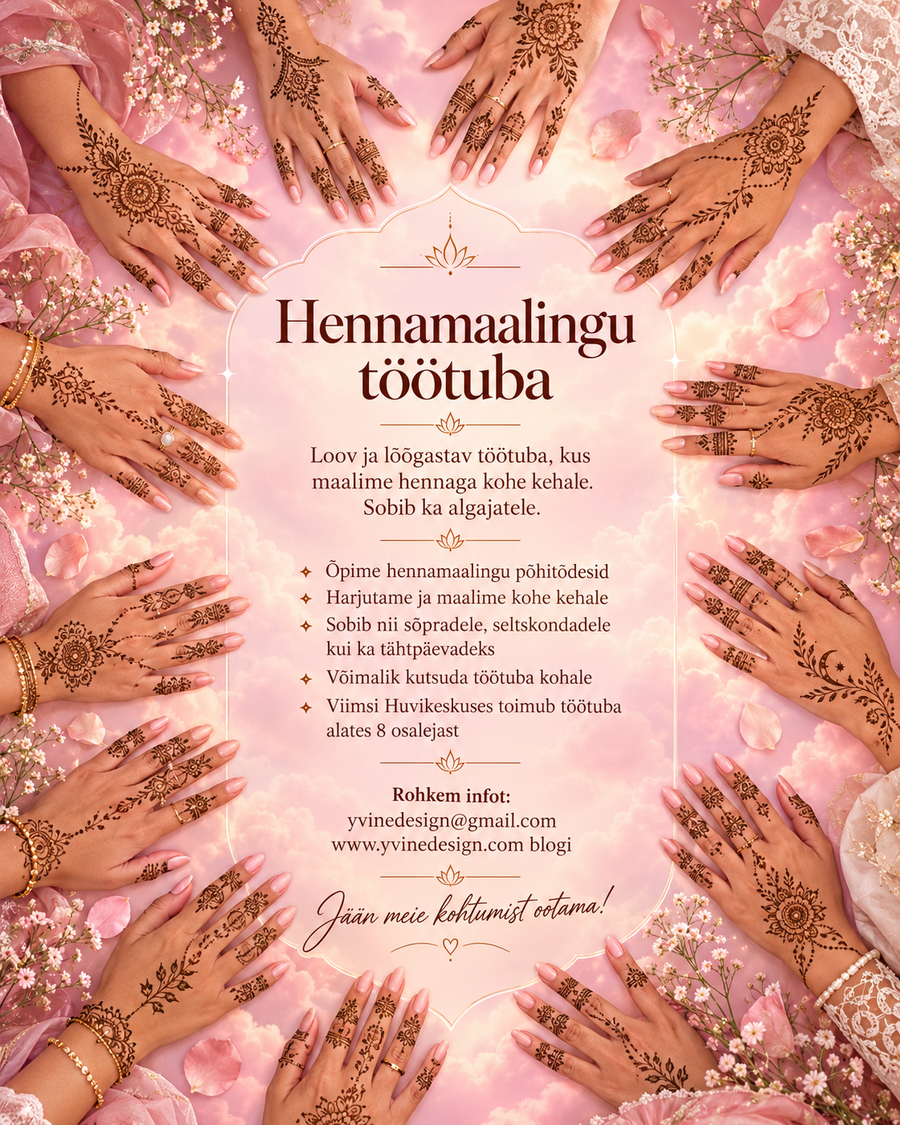
The first natural henna workshops take place on:
18 September, 18:00–20:00
25 September, 18:00–20:00
The venue is Viimsi Huvikeskus, Nelgi tee 1.
A cosy, calm atmosphere awaits, where you can step out of the everyday for a while, learn something new and create with your own hands.
Parking at Viimsi Huvikeskus is free.
The workshop suits both those meeting henna for the first time and those with previous experience. Children are also welcome together with adults.
You don’t have to be an artist
Just come with curiosity, an open mind and a wish to try something new.
Take two hours for yourself — get to know an ancient natural form of body art, practise with your own hand and create something that will stay on your skin for a while as a small, beautiful keepsake.
Yvette Aver / Yvine Design