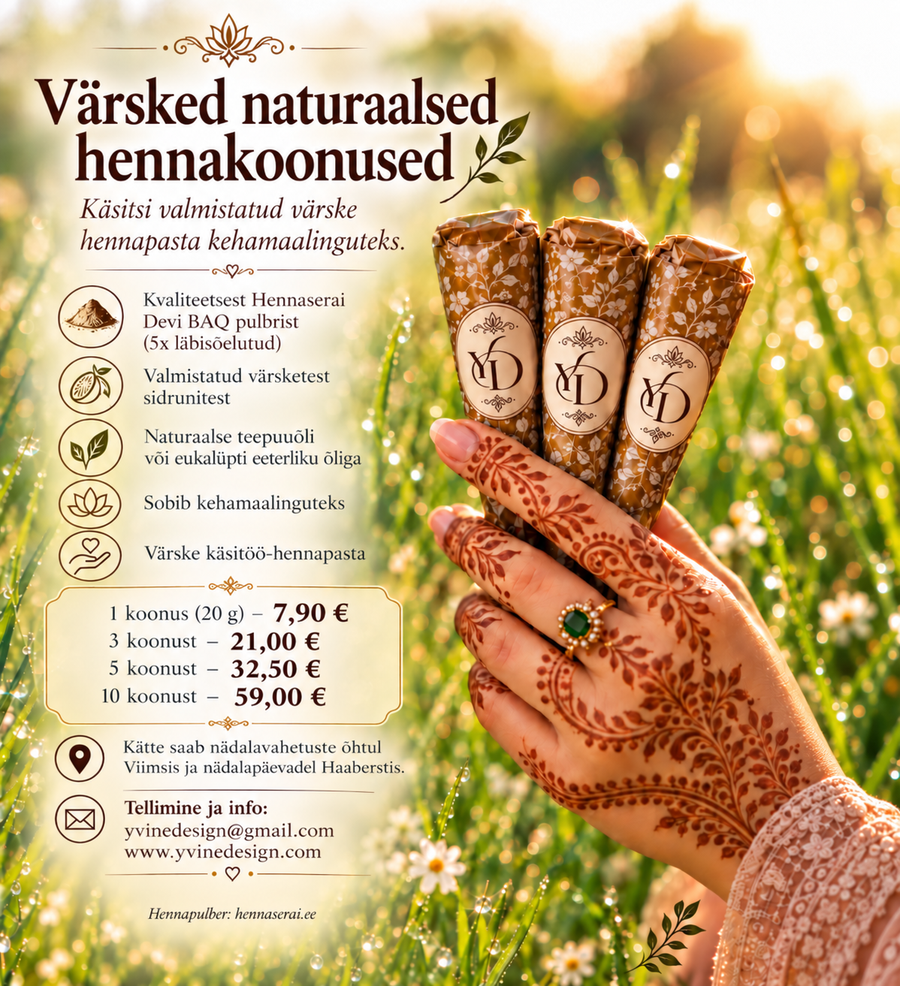
Fresh natural henna paste in cones — ready to use straight away
With henna, the most important thing for me is to know what I am putting on the skin. That is why I make my henna paste myself from fresh,...

Have you ever wondered, while painting, what paint is actually made of?
We are used to buying a ready-made tube, bottle or watercolour box from an art supply shop. We open the packaging and start painting. But we rarely ask where that paint comes from, what it is made of and how people painted before ready-made artists’ paints became part of everyday life.
At some point I started asking myself exactly these questions.
Looking at all those little plastic bottles and tubes that artists’ paints are sold in, their packaging and their journey from the manufacturer to us, a thought came to me:
Could paint be made differently?
At first glance Estonian nature can seem green, brown and grey.
But when you start looking at nature through the world of pigments, the picture changes completely.
Soil is no longer just brown.
Stone is not just grey.
A leaf is not just green.
In nature there are warm yellows, rusty reds, deep browns, greyish and greenish tones, and a great many shades in between.
Pigments and dyes can be obtained from various mineral and plant materials — for example soil, clay, charcoal, plants and leaves.
Some pigments give a strong, earthy tone. Some stay delicate and transparent. Some are very lightfast; others may change over time.
And for me, that is where one of the greatest charms of natural pigments lies.
Nature doesn’t always give us a ready-made, entirely predictable colour chart. It gives us a material that we have to learn to know.
That curiosity is what gave birth to my workshop on getting to know and painting with natural pigments.
Put most simply, a pigment is the substance that gives paint its colour.
But dry pigment powder on its own is not yet a ready paint.
For a pigment to stick to paper, canvas or another painting surface, it usually needs a binder.
And this is where the world of colour becomes especially exciting.
One and the same pigment can behave completely differently with a different binder, amount of water and surface.
In the workshop we don’t stop at talking about it.
We try it ourselves.
One technique we explore in the workshop is egg tempera.
In egg tempera, egg yolk is traditionally used to bind the pigment. It is a very old way of painting, used long before today’s ready-made paints existed.
With egg tempera you can achieve a beautiful, rich and lively paint surface.
In the workshop we look at:
how to prepare pigment for making paint;
how to mix pigment and binder together;
what the right consistency might be;
how the amount of water affects the result;
how to get a stronger, more opaque paint;
how to paint with egg tempera.
For me, one of the most special moments is when the dry pigment on the table really starts to become paint between your own hands.
It changes your whole understanding of colour.
Suddenly paint is no longer just something you buy in a shop.
You realise that you can make paint yourself.
Another binder we explore in the workshop is gum arabic.
Gum arabic is traditionally used to make watercolour paints. It helps the pigment adhere to paper and makes it possible to create a more transparent paint.
When we mix pigment with gum arabic and water, we get a completely different result than with egg tempera.
The paint can be:
light;
transparent;
layered;
delicate;
or much stronger and more intense.
It all depends on how much pigment, binder and water we use.
With more pigment and less water we get a fuller colour.
If we add more water and paint in thin layers, the result starts to resemble watercolour — the paint becomes transparent and the paper begins to glow through the layer of colour.
In the workshop you can experiment yourself with how very different paints can be born from a single pigment.
We also get to know gesso.
Gesso is a ground for the painting surface, used for example to prepare a canvas or a painting panel to take paint.
A primed surface behaves differently from ordinary paper or untreated material.
It gives us a good chance to compare how home-made paints behave on different surfaces.
In the workshop we look, for example, at how paints made from pigments look:
on high-quality watercolour paper and on a primed painting surface.
In this way one important principle of painting gradually opens up:
a good result doesn’t depend on the paint alone.
What matters is the pigment, the binder, the amount of water, the surface — and of course how the artist uses the paint.
This is what I most want to show in the workshop.
We can take one pigment.
Mix egg tempera from it.
Then try the same pigment with gum arabic.
Add more water.
Add less water.
Try it on paper.
Experiment on a primed surface.
And suddenly you realise that paint is not one finished, unchanging thing.
Paint is born from several things working together:
pigment + binder + water + surface + the artist’s hand.
Once you really try it out with your own hands, you start to see ready-made paints with quite different eyes.
What brought me to this subject was largely a question about how we consume today.
Acrylic paint is undoubtedly convenient. You open the bottle and paint.
But at some point I started looking at the dozens of little plastic bottles and tubes an artist can go through over the years.
They have to be made.
Packaged.
Transported.
And in the end, what’s left is the packaging.
That’s when I became curious, the other way round, about what our own surroundings have to offer.
And I discovered that part of our world of colour lies quite literally under our feet.
That doesn’t mean all modern art materials are bad or that we should stop using ready-made paints.
Nor does the word “natural” automatically mean that using any material is always environmentally friendly. When gathering from nature, too, we need to be mindful and sparing and take only what it is sensible to take.
But for me there is value already in knowing that another way also exists.
We can learn to ask:
Does everything always have to be bought ready-made?
Could we know how to make some art materials ourselves?
What colours does the nature of our own homeland offer us?
These questions changed my own relationship with art materials too.
For me this has been one of the most beautiful changes.
When I started working more with natural pigments, I also began to notice more colour in nature.
Where before I saw just soil, I started to notice different browns, yellows and reddish tones.
In stones I started to see greys, greenish tones and warm fieldstone colours.
In plants I began to notice nuances I used to walk straight past.
And at some point, walking in nature, a completely new question arises:
“What colour could this become?”
That curiosity is exactly what I want to pass on in my workshops.
Not only to teach a technique, but to help people notice.
No.
This workshop is perfect even for someone who has never made paint before and doesn’t consider themselves an artist.
No previous experience is needed.
It is above all a workshop of discovery, experimentation and creative learning.
You don’t need to know how egg tempera is made.
You don’t need to know what gum arabic does.
You don’t need to know how to make paint from pigments.
That’s exactly why we come together.
We look.
We mix.
We experiment.
We compare.
We paint.
And we learn through our own hands.
In the workshop:
we get to know different natural colour pigments;
we talk about where pigments can come from;
we learn the difference between a pigment and a ready paint;
we make paint from pigments ourselves;
we get to know egg tempera;
we learn to use gum arabic;
we make stronger and fuller colour tones;
we try more transparent, watercolour-like painting;
we explore how the amount of water and binder changes the paint;
we get to know gesso and a primed painting surface;
we paint on high-quality watercolour paper;
we compare how different pigments, binders and surfaces behave.
All the materials you need are provided.
Most important is to come with a curious mind and allow yourself to experiment.
You can read the theory in a book.
But the moment when real paint is born from dry pigment between your own hands is something you have to experience yourself.
The workshop on getting to know and painting with natural pigments costs €35 per participant.
The price includes the pigments and binders used in the workshop, high-quality watercolour paper and all other art supplies and tools needed.
Because something changed for me the moment I truly understood that you can make paint yourself.
Take dry pigment.
Add a binder.
Mix.
Experiment.
And watch real paint being born in front of you.
There is something very simple and at the same time extraordinarily powerful in that.
I also use modern art materials myself, and my aim is not to set them against natural materials.
Rather, I don’t want us to lose the knowledge of where colours began and how they can be made with our own hands.
I love how the world of natural pigments brings together so many things I love myself:
nature, art, handcraft, learning, experimenting and a more mindful attitude to materials.
That is exactly why I talk about this subject with such enthusiasm.
Because sometimes one small piece of knowledge is enough to start seeing the whole world around you a little differently.
And perhaps, after the workshop, the next time you go for a walk in the forest, by the sea or simply around your home, you too will see something more there besides soil, leaves and stones.
Colours.
Fee: €35 per person
The price includes all materials and tools used in the workshop.
Workshop dates and registration details can be found on the YVINE DESIGN events page.
YVINE DESIGN — art born of nature, hands and creativity.
With henna, the most important thing for me is to know what I am putting on the skin. That is why I make my henna paste myself from fresh,...
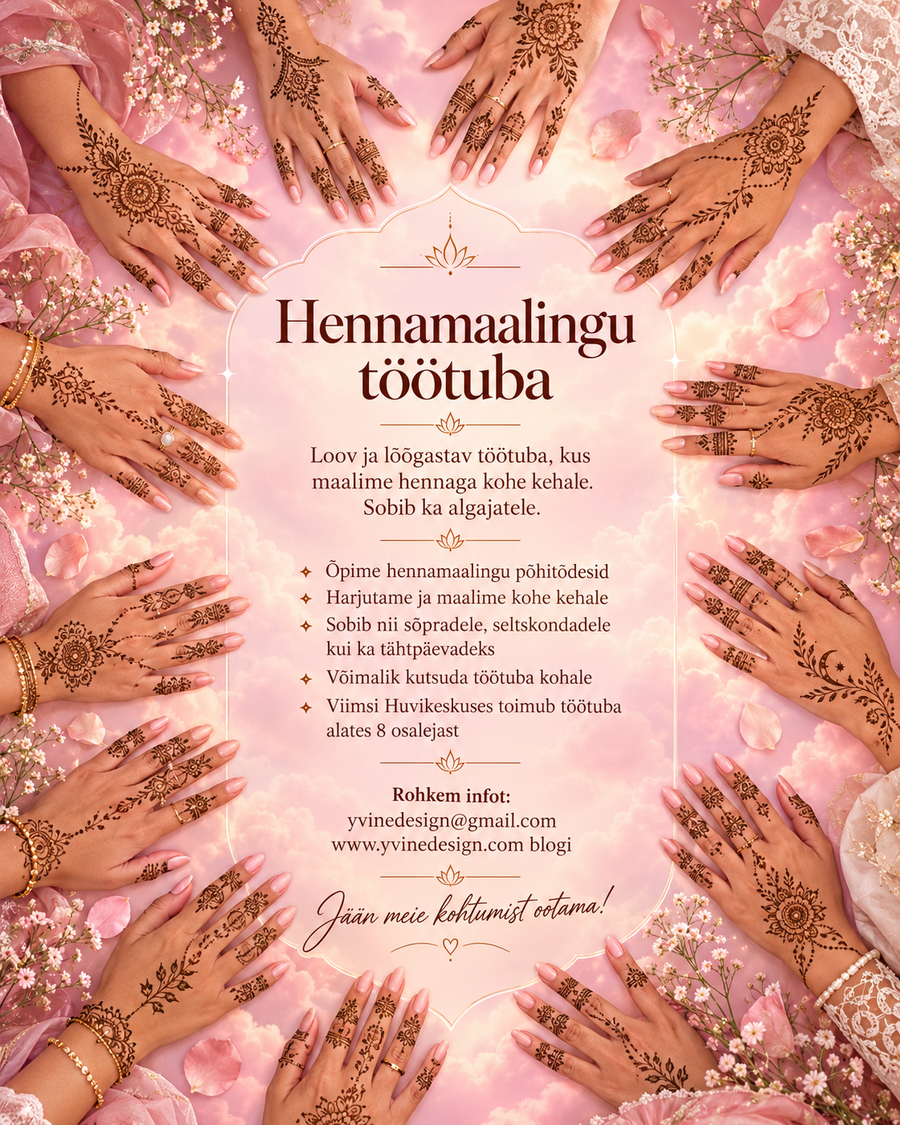
Sometimes the loveliest get-togethers happen when you can create something together with your own hands. Alongside the regular henna workshops, I also organise private henna workshops for smaller...
Yvine Design is a name that began to take shape as an idea back in 2021 in the United States, when I was working on various creative...